Kids School Admission Flyer Design Guide
What Is a Kids School Admission Flyer Design?
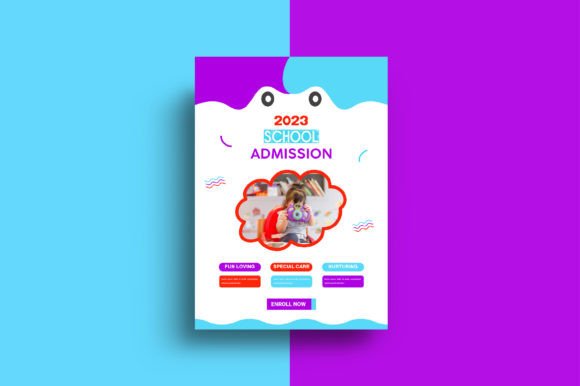
A kids school admission flyer design is a ready-to-use marketing template created specifically for promoting enrollment in schools, preschools, daycare centers, tutoring programs, or extracurricular classes. Instead of starting from scratch, you open a professionally laid-out file that includes background graphics, text placeholders, color schemes, and typography tailored to attract parents and guardians. These templates are usually built in popular design software like Adobe Illustrator and also include a high-resolution JPG for quick preview or sharing.
The main goal is to help you communicate essential admission details — such as age groups, curriculum highlights, open house dates, contact information, and registration deadlines — in a visually appealing way. A well-designed flyer can make your school stand out on bulletin boards, social media posts, email newsletters, or printed handouts.
Key Features That Make These Templates Stand Out
When you invest in a kids school admission flyer design, you get far more than just a pretty picture. The typical template package includes several professional-grade features that save time and ensure high-quality output:
- Printable size with 300 DPI resolution — This standard print resolution ensures that every detail remains sharp and crisp when printed on flyers, posters, or brochures. You can confidently take the file to a commercial printer or use your own office printer.
- Illustrator EPS and JPG files — The EPS vector file allows infinite scaling without losing quality, while the JPG serves as a convenient preview or quick-use image. Designers can edit the EPS in Adobe Illustrator to tweak colors, move elements, or swap text.
- CMYK color mode — Colors are set for print (Cyan, Magenta, Yellow, Black) rather than screen (RGB). This means the vibrant shades you see on your monitor will match the final printed piece much more accurately.
- Easy to edit — Good templates use organized layers, clearly named text fields, and simple guides. Even if you are new to design software, you can replace placeholder text with your school name, tagline, and call to action.
- Free font use — The fonts used in the template are either standard system fonts or freely available fonts that you can download legally. You are not forced to purchase expensive typefaces just to use the design.
- 100% vector elements — All graphic elements — borders, icons, shapes — are vector-based. You can resize, recolor, or rotate them without pixelation. Only the embedded images (if any) are raster, and in many templates images are not included to give you full creative control.
- Images not included — This is important to note. The template includes the layout and design, but you will need to provide your own photos of children, school facilities, or other relevant visuals. This ensures you use authentic images that represent your actual school environment.
Why Use a Professional Flyer Template for School Admission?
Creating a compelling flyer from scratch requires design skills, time, and often expensive software. A kids school admission flyer design removes these barriers. Here is why many educators, small business owners, and marketing coordinators turn to templates:
- Save hours of work — Instead of experimenting with layout and color schemes, you start from a proven design that already looks professional.
- Consistent branding — You can adjust the template to match your school's colors and logo. Use the same template for multiple admission cycles or events to build recognition.
- Cost-effective marketing — Hiring a graphic designer for a custom flyer can cost hundreds of dollars. A template costs a fraction of that and can be reused year after year with simple text updates.
- High print quality — With 300 DPI and CMYK colors, the final printed piece looks as good as something produced by a marketing agency.
- Flexibility across channels — Use the EPS for large posters, the JPG for social media posts or email attachments. The vector format means you can resize the flyer to different dimensions without starting over.
Practical Use Cases and Applications
These flyer templates are surprisingly versatile. Here are some realistic scenarios where a kids school admission flyer design proves valuable:
- Preschools and daycare centers — Announce new enrollment periods, highlight play-based learning approaches, and showcase small class sizes. A warm, colorful flyer put up in community centers or pediatric waiting rooms reaches parents directly.
- Private K–12 schools — Use the flyer as part of an open house invitation. Include bullet points about STEM programs, arts, sports, and after-school care. Distribute printed copies at local libraries and family events.
- Tutoring centers and enrichment programs — Even if you offer after-school math or language classes, a professional flyer adds credibility. Emphasize student-teacher ratios and progress tracking.
- Summer camps and workshops — The same template can be repurposed for seasonal programs. Change the headline to “Summer Coding Camp” or “Art & Music Workshop” and update the dates.
- Online promotions — Post the JPG version on your school’s Facebook page, Instagram, or WhatsApp groups. Parents often share these posts, expanding your reach organically.
- Direct mailings — Print the flyer at full size and include it in welcome packets for new families or in neighborhood mail drops.
One common use case is a new preschool owner who needs to create buzz in the local community. With the template, they can swap in their own photos of the classroom, update the contact details, and print 50 copies in one afternoon. No learning curve, no design panic.
Important Considerations Before Choosing a Template
While a kids school admission flyer design offers tremendous value, there are a few things to keep in mind to get the best results:
- Images are your responsibility — Since the template does not include images, you need high-resolution photos that represent your school positively. Avoid low-quality cell phone snapshots — they will stand out against the crisp vector elements.
- Software requirements — The EPS file requires Adobe Illustrator or a compatible vector editor such as Affinity Designer or Inkscape. If you only have a basic image editor, the JPG version may be easier to work with for simple text overlays.
- Font licensing — Even though the template uses free fonts, you still need to download and install them correctly. Double-check that the fonts are truly free for commercial use if you plan to distribute the flyer widely.
- Customization limits — Templates give you a strong starting point, but you may want to rearrange elements to fit more text or a different image orientation. Basic editing skills are helpful. If you run into trouble, the seller usually offers support — just reach out for help with customizing.
- File organization — Keep the template files together in a folder. If you ever need to make a last-minute change, you can open the EPS and adjust without losing layers or fonts.
How to Get the Most Out of Your Flyer Template
After purchasing a kids school admission flyer design, follow these straightforward steps to transform the template into a polished, effective marketing tool:
- Open and explore the file — Whether you use the EPS in Illustrator or the JPG in a photo editor, take a few minutes to understand the layout. Identify text layers, image placeholders, and background graphics.
- Gather your content — Write a short, benefit-driven headline. List key admission details: grades offered, location, fee structure (or “contact for fees”), and a clear call-to-action like “Enroll Today” or “Schedule a Tour”.
- Replace placeholder text — Click on each text area and type your own information. Use fonts included in the template or substitute with similar free fonts if you prefer.
- Add your images — Insert your best photos. Crop them to fit the designated image frames. If the template uses image masks, learn how to place images inside those masks (Illustrator makes this easy with clipping masks).
- Adjust colors if needed — Many templates use global color swatches, so changing one color automatically updates all matching elements. Adapt the color scheme to your school’s branding.
- Export and print — Save a copy as a high-resolution PDF or JPG. For print, keep CMYK mode and 300 DPI. For web, you can convert to RGB and reduce resolution to 72 DPI to keep file sizes manageable.
If at any point you feel stuck — perhaps you need to add an extra section or resize the flyer to a different format — do not hesitate to contact the template creator. Most sellers are happy to guide you through basic customizations or even perform them for a small fee.
Final Thoughts
Kids school admission flyer design is a practical, time-saving resource for anyone who needs to communicate enrollment opportunities in a visually compelling way. The combination of ready-to-edit files, print-ready resolutions, and vector flexibility makes it an excellent choice for schools, learning centers, and community programs with limited design budgets. By understanding the features and following good preparation practices, you can produce a flyer that not only informs parents but also builds trust and excitement about your educational offering. Whether you are a first-time user or a seasoned marketer, these templates free you to focus on what matters most: connecting with families and filling seats.